Crushed limestone — long-term ph maintenance
Natural crushed limestone — pure calcium carbonate. Slower to act, but depending on rainfall the effect lasts close to a decade. It is not possible to over-lime soil with this material.
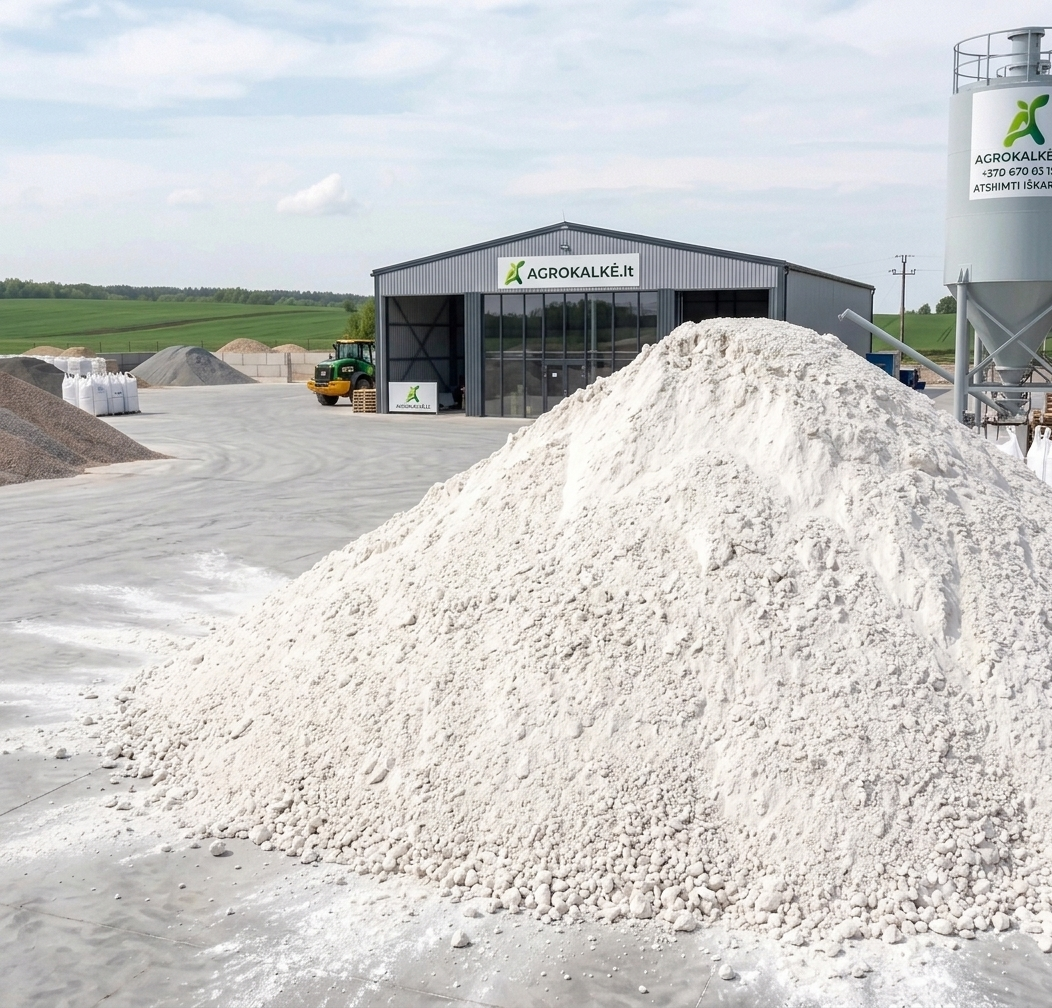
Technical data
| Base material | natural calcium carbonate (CaCO₃) |
|---|---|
| Ca expressed as CaCO₃ | 94.01 % |
| Reactivity | 21.16 % |
| Moisture | 4.28 % |
| Particle sizes | 0–18 mm and 0–5 mm |
| Suited to | clay and heavy loam soils, long-term pH balance |
| Onset of effect | about one year after application |
| Duration | up to a decade, depending on rainfall |
| Safety | does not harm soil microflora; over-liming is not possible |
| Packaging | bulk, or 1000 kg big bags |
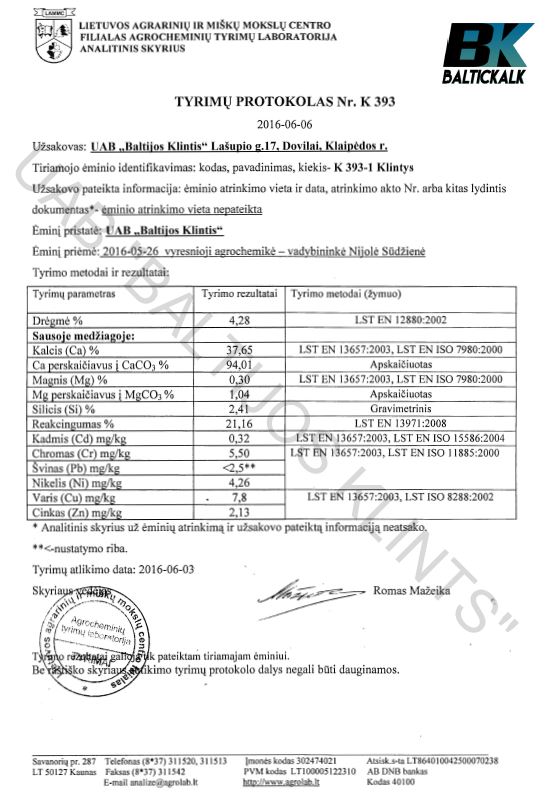
Crushed limestone — laboratory results
Tested by the same independent laboratory. Report No. K 393, 6 June 2016.
| Ca expressed as CaCO₃ | 94.01 % |
|---|---|
| Calcium (Ca) | 37.65 % |
| Reactivity | 21.16 % |
| Magnesium (Mg) | 0.30 % |
| Mg expressed as MgCO₃ | 1.04 % |
| Silicon (Si) | 2.41 % |
| Moisture | 4.28 % |
Heavy metals
| Cadmium (Cd) | 0.32 mg/kg |
|---|---|
| Lead (Pb) | < 2.5 mg/kg (below detection limit) |
| Chromium (Cr) | 5.50 mg/kg |
| Nickel (Ni) | 4.26 mg/kg |
| Copper (Cu) | 7.8 mg/kg |
| Zinc (Zn) | 2.13 mg/kg |
Low reactivity (21.16 %) means limestone dissolves slowly — so its effect is long-lasting and over-liming is not possible. For comparison, agricultural lime has 72.58 % reactivity.
Where it fits
Heavy clay soils
On clays and heavy loams, limestone improves not only pH but also structure — the soil drains better.
Long planning horizon
One application can last close to a decade. For farms with a rotation plan, it is the lowest cost per hectare per cycle.
Wet and high-rainfall areas
Slow dissolution means the material is not washed out in the first wet autumn.
Documented input quality
Heavy-metal content is published in the laboratory report — useful for import paperwork and quality schemes.
Prices and delivery terms
Indicative prices, so you do not need to ask just to get a ballpark. Exact quotes for your port or farm within one working day.
EXW Venta (ex works)
| Agricultural lime, bulk | from €30/t |
|---|---|
| Crushed limestone, bulk | from €24/t |
| Big bag 1000 kg | from €98 per bag |
| Big bag 500 kg | from €72 per bag |
| Big bag 200 kg | from €52 per bag |
FCA Port of Klaipėda
| Transport Venta → Klaipėda port | from €18/t |
|---|---|
| Minimum export order | 24 t (one truckload) |
Prices exclude VAT. Final price depends on volume and delivery terms.
EXW Venta
You collect at our production site in Venta, near the Latvian border. Loading included.
FCA Port of Klaipėda
We deliver to the port. Sea freight, insurance and customs at destination are arranged by the buyer.
A price per tonne means little on its own. Our agricultural lime has a reactivity of 72.58 % and a neutralising value of 49.42 %, confirmed by an independent laboratory. A cheaper material with lower reactivity delivers less liming power per tonne — which matters even more when freight is part of the cost.
Frequently asked questions
How many tonnes of lime do I need per hectare?
It depends on soil pH. A typical rate is 2–3 t/ha: about 3 t/ha for strongly acidic soil (pH up to 4.5), 2.5 t/ha for moderately acidic soil (pH 4.6–5.2) and 2 t/ha for slightly acidic soil (pH 5.3–5.8). Heavy clay soils need more; light sandy soils need less.
What is the difference between agricultural lime and crushed limestone?
Agricultural lime is finer and more reactive (72.58 % reactivity) — it raises pH quickly but the effect is shorter. Crushed limestone is coarser and dissolves slowly (21.16 % reactivity), acting as long-term pH maintenance; it is pure calcium carbonate, so over-liming is not possible. Many farms use both: limestone as the base, agricultural lime for fast correction.
What are your delivery terms for export?
We quote EXW Venta (you collect at our production site) or FCA Port of Klaipėda (we deliver to the port; sea freight and onward logistics are arranged by the buyer). Delivery by truck directly to the farm is available on request for nearby markets such as Latvia.
Can I see the laboratory reports?
Yes. Both products were tested by the Agrochemical Research Laboratory of the Lithuanian Research Centre for Agriculture and Forestry. All measured values are published on our Quality & lab results page, including heavy-metal content for crushed limestone.
When is the best time to apply lime?
Autumn after harvest, before ploughing, is ideal: the lime has time to react before the next season. Early spring also works if the soil is trafficable and the lime is incorporated before sowing.
How fast does soil pH rise?
Agricultural lime starts working within 2–6 weeks of moisture, with a clear pH change after 6–12 months. Crushed limestone begins acting after about a year, but the effect lasts close to a decade depending on rainfall.
Can lime be applied together with manure or slurry?
It is not recommended. Raising pH at the same time as applying ammonium-based fertilisers increases ammonia loss. Keep at least 2–3 weeks between them, or lime in autumn and spread organic manure in spring.
What packaging is available?
Bulk by tipper truck, or big bags of 200, 500 and 1000 kg. Crushed limestone is supplied in bulk or 1000 kg big bags.
How much does agricultural lime cost?
Agricultural lime is from €30/t EXW Venta, excluding VAT. Final price depends on volume and delivery terms — contact us for a quote to your port or farm.
Also available
Need an exact price?
Tell us the quantity and destination — we reply with a quote for EXW Venta or FCA Klaipėda.